The session, and who was in the room
Arrangers, contractors and the players who appear on hundreds of records without their names on any of them.
Credited on the label, absent from the credits
The Shirelles' name is on the record. Florence Greenberg's Scepter label is on the record. Sometimes Luther Dixon gets a production credit. Nobody else does. The arrangers, the session contractors, the string players, the rhythm section — they were in the room, they made the sound, and they were paid a flat fee and sent home. Their names belong to the history, not to the industry's paperwork.
That invisibility was structural, not accidental. The recording industry of the early 1960s ran on a hire-for-sessions model that kept studio musicians off the credits by convention and, frequently, by contract. The American Federation of Musicians set the scale rates ↗ and guaranteed the session fee, but it did not require that a player's name appear anywhere on the finished product. You hired a contractor — one experienced musician who kept a book of reliable players and assembled the room to the arranger's specification. The contractor made one call. The arranger handed out the charts. The tape rolled. None of those names went on the label.
The arranger's chart told every player exactly what to play and when to stop playing.
What the arranger actually did
Luther Dixon produced the Shirelles records — choosing the material, shaping the arrangement, directing the session — but the line between producer and arranger was not always where it looked. Dixon did write arrangements, and he had a clear conception of what a Shirelles record should feel like: a rhythm-section bed wide enough to hold the group's voices, with something on top that gave the song scale without burying the lead. Strings were not decoration; they were architecture. When Dixon slowed "Will You Love Me Tomorrow ↗" and brought the strings in under the bridge, the string writing was doing load-bearing work, holding the tension the lyric required.
Whoever put those arrangements on manuscript paper was working to that specification. Session arrangers of the period operated at 1650 Broadway and the surrounding blocks, moving between publishers, producers and labels on a freelance basis. Some had names that are recoverable now — Stanley Applebaum worked extensively in the building, as did Teacho Wiltshire, who is documented on a number of Scepter sessions — but the full picture of who wrote what chart for which session is partly inferential, reconstructed from session logs that were not always preserved and from the memories of the musicians themselves.
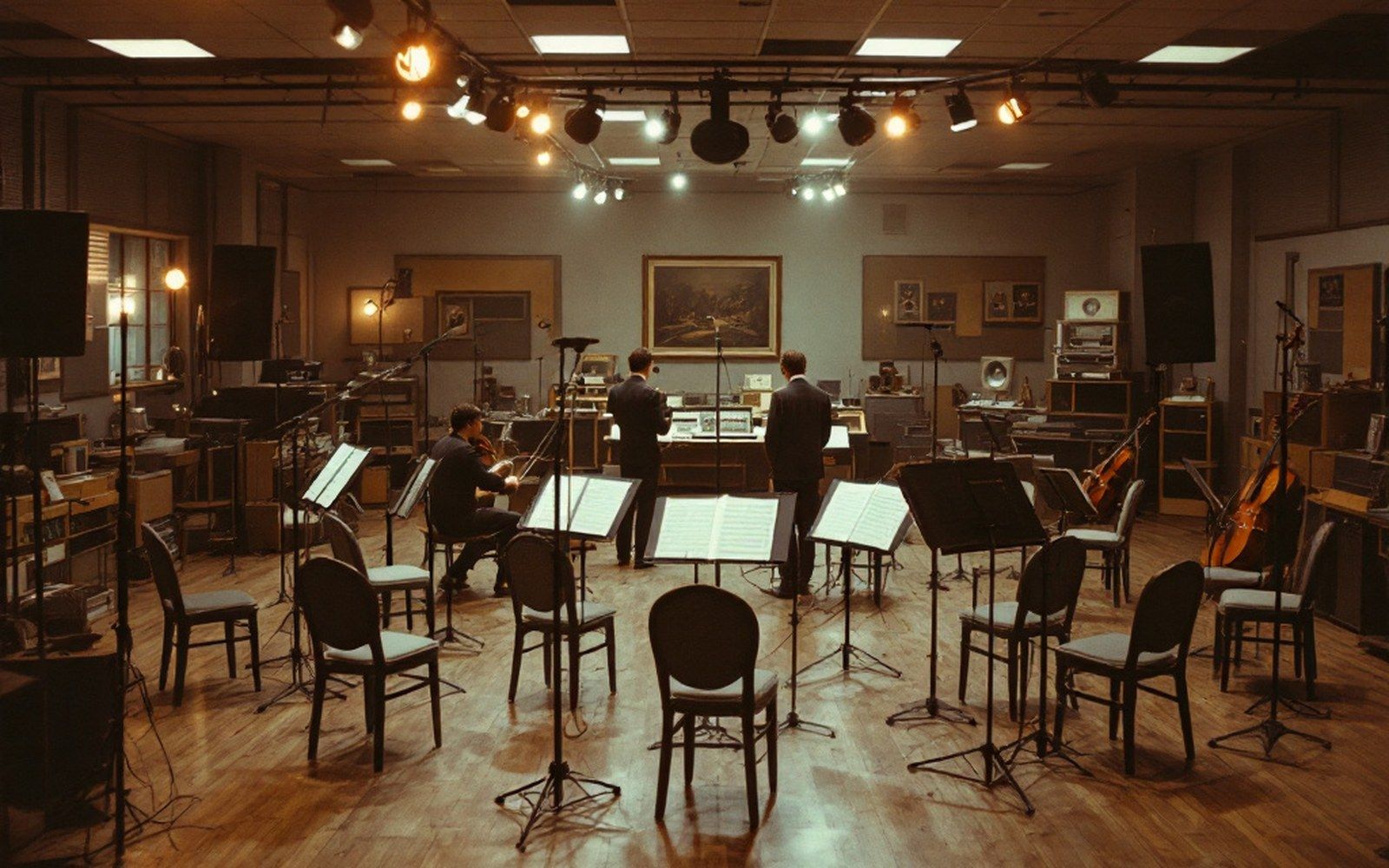
The arranger's chart told every player exactly what to play and when to stop playing. A Shirelles session at a studio like Bell Sound or Mirasound in New York meant booking musicians to the chart: a rhythm section of piano, bass, drums and likely guitar; a brass section if the arrangement called for it; a string section if it did. Each section might be tracked separately or together depending on the room and the budget. For the bigger productions — the ones that went to number one — the room was full.
The players, the contractors, and the clock
The session contractor was often the lead player in one section, earning slightly above scale for the administrative work of assembling the room. He carried a notebook of players who could sight-read anything, who showed up on time, and who understood that a three-hour session had to finish in three hours because the next session had already booked the room. The economics were that direct: studio time was priced by the hour, the musicians were paid by the session, and there was no overtime budget on a Scepter record.
New York session musicians of this period were an unusually concentrated talent pool. The same players who recorded a Shirelles side in the morning might record a jazz date in the afternoon and a jingle in the evening. Many of them were formally trained, some with conservatory backgrounds, all of them experienced enough to work from a chart without a run-through. The rhythm section could lock a groove in two takes. The strings, reading precisely, could lay down a part that sounded like it had been rehearsed for days.
What this produced, on the best Scepter sessions, was a kind of tension between precision and feeling that is still audible on the records. Baby It's You is the example most often cited: the celeste part, precise as clockwork; the low brass, careful and restrained; the vocal sitting in front of everything at a proximity that was uncommon for the era. Someone decided where to put the microphone. Someone decided how much reverb the room should add. The engineer's name is also absent from the label.

What stayed invisible and what didn't
Dixon's credit, when it appears, is as producer or sometimes as co-writer. The Goffin and King credit on "Will You Love Me Tomorrow" is a songwriter credit, which meant publishing royalties, which meant money — the reason credits mattered at all to the people who held them. An arranger working for hire on a flat fee had no royalty position in the record, so there was no commercial logic pressing labels to identify them. The musician's session fee, set by AFM scale, was the full extent of their financial relationship with any given record, however many copies it sold.
This is not merely a historical footnote. The Shirelles' recordings sold in quantities that generated substantial revenue at Scepter, and the litigation that later surrounded the group's earnings makes clear that the question of who got paid what — and when, and whether — was contested territory throughout the label's existence. The musicians in the room were actually the best-protected participants in one narrow sense: their scale fee was guaranteed, paid on the day, and not subject to the accounting practices that held the group's own royalties in a trust they struggled to access. A union session fee is a floor, not a ceiling, but at least it was a floor with a union enforcing it.
The group's name was on the record. The group's leverage was not.
The session as an artifact
What the session produced is recoverable, if incompletely, through the discography that researchers have assembled from label copy, session logs, Billboard chart data and the records themselves. The personnel on any given date — who played, who arranged, who contracted — often has to be reconstructed from secondary sources, from interviews conducted decades after the fact, and from the kind of institutional memory that the American Federation of Musicians and the studios' own files sometimes preserved and sometimes didn't.
What is not in doubt is what the sessions produced: a run of recordings between 1960 and 1963 that changed what a pop record could sound like, changed who was on the radio, and established a template that songwriters and producers reached for long after the moment had passed. The players who made those records are mostly unnamed in the official history. The music names them anyway, in the only language that matters: the sound they made together, in a hired room, on an afternoon that was over in three hours.